


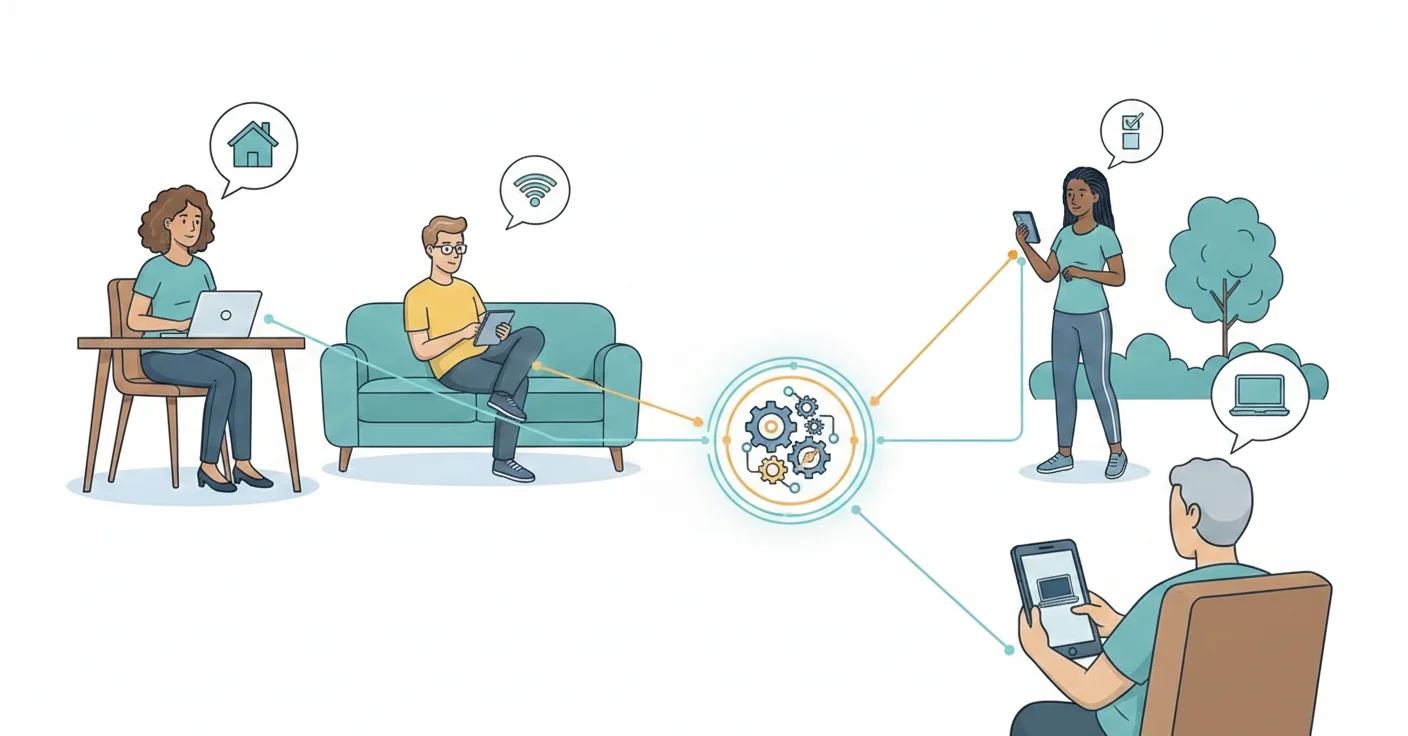
The traditional image of a CRO is a large organisation with offices in multiple countries, a substantial infrastructure of project managers, and a sprawling supply chain of vendors. It is also an organisation with high fixed costs, complex internal processes, and billing models that prioritise hours over outcomes.
A different model has emerged — one built from the ground up around remote working, lean teams, and technology-enabled delivery. For the right kinds of studies, it offers something compelling: faster set-up, lower overhead, and teams that are genuinely focused on the science rather than the machinery. Decentralised approaches to trial delivery have become an active area of methodological research in their own right — the RADIAL project (Remote And Decentralised Innovative Approaches to Clinical Trials) exists specifically to study how these approaches perform, rather than assuming the answer.
What remote-first actually means
Remote-first is not the same as remote-capable. Many organisations have added distributed working on top of existing structures — keeping the same processes, the same hierarchies, and the same communication overhead, but doing it over video calls instead of in meeting rooms. That adds friction without gaining efficiency.
A genuinely remote-first CRO is built differently:
- Teams are structured for asynchronous and distributed collaboration from the start, not retrofitted for it
- Processes are documented and digital rather than embedded in local institutional knowledge
- Technology does the coordination work that would otherwise require co-location
- Talent is hired for capability, not geography, meaning sponsors can access expertise that a fixed-location organisation couldn't employ
The result is a model where overhead is structurally lower — not just operationally managed.
Where the cost savings come from
Cost reduction in a remote-first CRO is not achieved by cutting corners on quality or reducing the expertise deployed on a study. It comes from removing the infrastructure that large traditional organisations require to sustain themselves:
- No expensive city-centre offices, with the associated facilities, management, and real estate costs
- No layers of regional management coordinating between locations
- No complex internal vendor and procurement processes that add margin at every step
- No overstaffed delivery teams built to absorb uncertainty
When those structural costs are removed, a greater proportion of the budget goes directly into the study: data collection, monitoring, analysis, and the people doing the scientific work.
For sponsors running nutritional, observational, or real-world evidence studies — where budgets are often tighter than in large-scale pharmaceutical contexts — this structural efficiency is not a minor detail. It can be the difference between a study being feasible and it not happening at all.
Remote delivery and study quality
There is sometimes a concern that remote working compromises oversight or quality. In practice, for non-CTIMP, observational, and nutritional studies, the evidence points the other way.
Remote-first teams tend to invest more heavily in digital infrastructure — secure data platforms, electronic participant-reported outcomes, remote monitoring dashboards, and systematic communication tools. The result is better documentation, more systematic tracking, and cleaner audit trails than processes built around physical paper and in-person visits.
A literature review of clinical research nurse involvement in decentralised trials found that the nursing role doesn't disappear in a remote model — it shifts, toward coordinating remote participant contact, supporting technology use, and maintaining the same clinical oversight through different channels. Quality in a remote-first study depends on that role being properly resourced, not assumed away because there's no physical site to staff.
Participant-facing processes also benefit. When research teams are not anchored to a physical location, they can engage participants wherever they are — through digital consent, remote check-ins, and at-home data collection. This reduces the burden on participants and consistently improves retention. A real-world example of what a fully remote pathway can look like: a UK weight-management programme delivered alongside GLP-1/GIP-1 receptor agonist medication was studied entirely through its existing digital delivery channel, with no requirement to retrofit a clinic-based recruitment or data collection process around it.
The limits of the model
Remote-first is not right for every study. Studies requiring complex interventional procedures, specialist clinic infrastructure, or frequent in-person clinical assessment need physical site infrastructure. The remote model works best when:
- Participants can complete study activities at home or in community settings
- Data can be collected digitally or through local sampling arrangements
- Monitoring can be conducted remotely with appropriate risk-based oversight
- Site coordination can be managed through digital tools rather than on-site presence
For the range of studies Comet Clinical specialises in — non-CTIMP, nutritional, observational, and real-world evidence — these conditions are typically met. The result is evidence generated more efficiently, with lower participant burden, from a broader and more representative population than clinic-based alternatives allow.
What sponsors should look for
When evaluating a remote-first CRO, the right questions are about substance rather than style. Does the team have genuine expertise in the relevant study types, or are they generalists who happen to work remotely? Is the technology infrastructure robust, or are they using consumer tools for professional research? Is the lean team model genuinely lean, or is it under-resourced?
The goal is a CRO that is efficient because it is well-designed — not because it has cut corners on capability or governance. Those are very different things, and the distinction matters when the evidence you are generating needs to hold up to scrutiny.
References
- Clinical research nurse utilisation and role in the conduct of decentralised clinical trials: a literature review
- Remote And Decentralised Innovative Approaches to Clinical Trials (RADIAL)
- Does use of the Voy Program improve weight loss percentage and other health outcomes in a population already taking GLP/GIP-1RA medication?