


Recruitment is consistently one of the biggest challenges in nutritional research. Studies overrun their timelines, exhaust their budgets chasing participants, and sometimes close early without reaching the sample size they need to answer their question. The problem is rarely a shortage of eligible people — it is a gap between who is eligible and who actually consents and shows up.
Understanding why that gap exists — and what genuinely closes it — is worth more than any recruitment target written into a protocol.
Why nutritional research recruitment is different
Recruiting participants for a nutritional study is different from recruiting for other types of research in ways that are often underestimated.
There is no treatment benefit to offer. In many intervention studies, participants may be motivated partly by the possibility of direct personal benefit. In observational nutritional research, or studies testing dietary patterns, the benefit is to science — and that is a less compelling reason to rearrange your daily life around a study.
The intervention burden is often high. Dietary studies frequently require participants to change what they eat, complete food diaries, attend assessments, or provide biological samples. Each requirement is a reason to decline.
The eligible population is often broad but hard to reach. Most nutritional studies recruit from the general population or community settings rather than clinical populations with established patient pathways. There is no clinic waiting room to approach.
What actually works
Start with the participant experience, not the protocol requirements. The most common recruitment failure begins with a protocol written around what the study team needs rather than what participants can realistically do. Before finalising the protocol, map the participant journey from first contact to study completion. Where are the friction points? Which requirements can be simplified? What would make it easier to say yes?
Use community channels, not just clinical ones. For studies recruiting from the general population, community organisations, workplaces, sports clubs, faith groups, and online communities often outperform clinical recruitment routes. People who are already engaged in a community context are more likely to participate and more likely to complete.
Make remote participation the default. Digital consent, online questionnaires, and at-home sample collection dramatically reduce the time and effort required to participate. For nutritional studies that don't require in-person clinical procedures, there is usually no good reason why participation should require a clinic visit. Remote-first participant pathways consistently improve both recruitment rates and retention.
Be honest about burden upfront. Studies that downplay participation requirements to improve initial consent rates often suffer from high dropout and poor data quality. Transparent recruitment — clearly explaining what participation involves and who it is genuinely suited to — produces smaller but more committed participant pools.
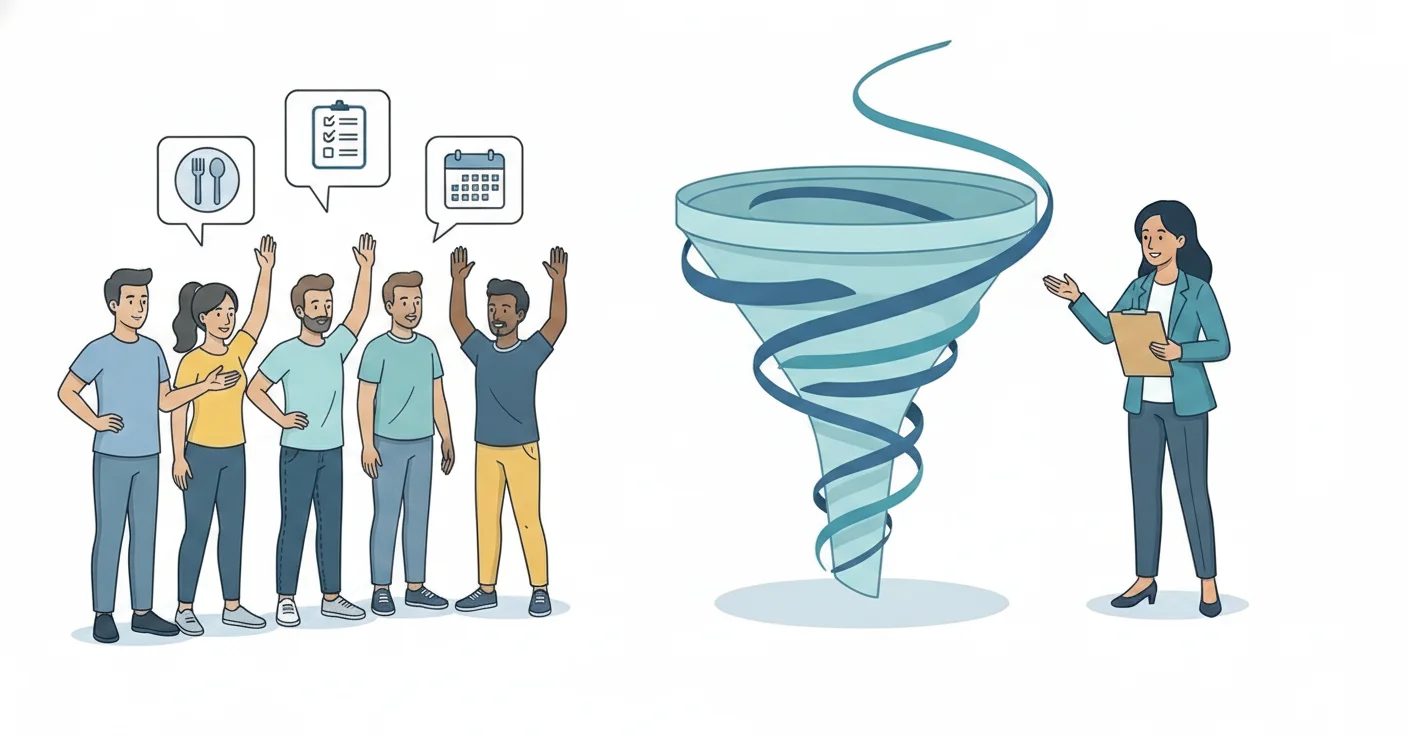
Build in screening efficiency. Multi-stage screening, where a brief initial contact filters out ineligible participants before investing in full informed consent, reduces the burden on both participants and study teams. Online pre-screening questionnaires can process large numbers quickly and identify the genuinely eligible population far more efficiently than telephone-based approaches. A typical funnel looks something like this:
Each stage should filter, not just delay — if a stage isn't removing a meaningful proportion of ineligible contacts, it's adding friction without adding value.
What this looks like in practice
Rotherham Doncaster and South Humber NHS Foundation Trust's feasibility study of an online food and mood knowledge intervention is a useful illustration of remote-first recruitment done deliberately: the intervention itself is delivered online, which means the recruitment pathway can be online too, rather than requiring a clinic visit just to get people through the door. Similarly, Cedars-Sinai's nutrition intervention feasibility study for patients with prediabetes is based at a Federally Qualified Health Center specifically — meeting a population that already has an established contact point, rather than trying to build one from scratch. In both cases, the recruitment strategy follows from where the eligible population already is, not from what's administratively convenient for the study team.
The retention problem is equally important
Recruitment that doesn't account for retention is solving the wrong problem. A study that recruits 150 participants but retains 80 at follow-up is generating a biased sample — and the bias is not random. The participants who drop out are systematically different from those who stay.
Retention starts with recruitment: people who fully understand what they are signing up for, who feel the study is relevant to their life, and who trust the research team are more likely to complete. No amount of follow-up communication compensates for a participant who was never fully committed.
For long-running dietary studies, regular touchpoints — brief check-ins, progress updates, and acknowledgement of participants' contribution — substantially reduce dropout. These need to be proportionate and not burdensome in themselves; a monthly email is very different from a monthly phone call.
A note on diversity
Nutritional research has a diversity problem. Many studies, particularly those using convenience sampling from university settings or online platforms, recruit participants who are disproportionately younger, more educated, and more health-conscious than the general population. The conclusions drawn from those samples may not generalise — and in nutritional science, generalisability matters enormously.
Reaching more diverse participant populations requires active effort: partnering with community organisations that serve different demographic groups, providing participation materials in accessible formats, removing barriers such as complex consent processes or inaccessible study locations, and designing studies that are genuinely inclusive rather than accessible only to the already-engaged.
This is not a box-ticking exercise. It is a scientific requirement. Recent commentary on dietary guidance for adolescents makes a related point from the guidance side rather than the research side: generic, one-size-fits-all advice serves the population it was built around, and everyone else gets a worse fit. The same logic applies to recruitment — a study built around the convenience sample it's easiest to reach will produce evidence that fits that sample best, and fits everyone else a little less.
Choosing a recruitment channel
Different channels suit different studies, and the choice should follow from where the eligible population actually is, not from which channel the study team is most used to:
| Channel | Best suited to | Main limitation |
|---|---|---|
| Clinical/NHS pathways | Populations already engaged with a relevant health service | Excludes people not currently in contact with that service |
| Community organisations | Broad general-population studies, harder-to-reach groups | Requires genuine partnership, not a one-off flyer |
| Digital/online | Remote-first, low-burden studies with online components | Skews toward digitally engaged, often younger participants |
| Workplace/institutional | Occupational health and behaviour studies | Sample is bounded by the institution, not the wider population |
No single channel is sufficient on its own for most nutritional studies — the strongest recruitment strategies usually combine two or three, chosen to offset each other's blind spots rather than duplicate the same reach.