


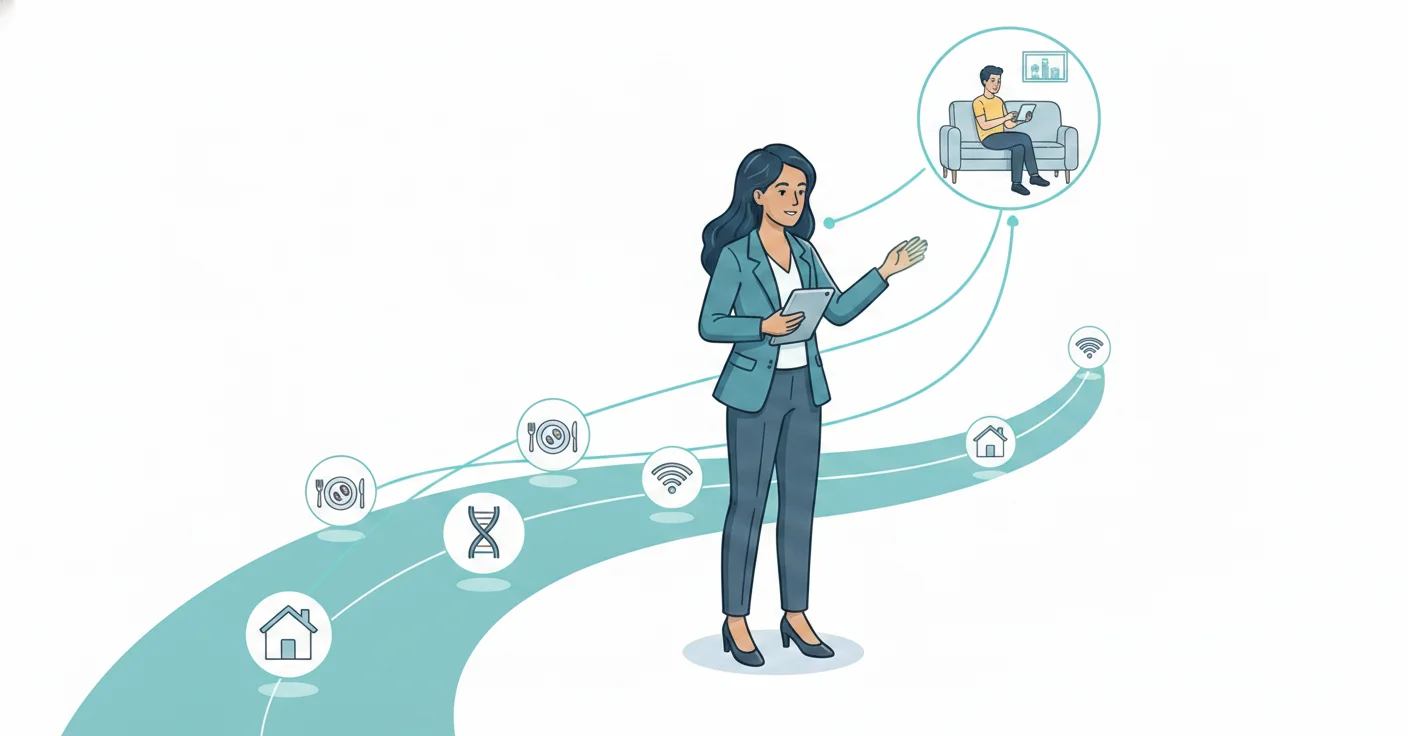
Decentralised studies — where some or all procedures move away from a central clinical site and into participants' homes or local community settings — have attracted significant attention across clinical research in recent years. For nutritional research specifically, decentralisation is not a new trend so much as a natural fit: many nutritional studies are already conducted, or could readily be conducted, without the clinical infrastructure that other research types require.
Understanding where decentralisation genuinely adds value — and where it introduces complications — is essential for anyone designing a nutritional study today.
Why nutritional research is well-suited to decentralisation
The procedures required for most nutritional studies are relatively compatible with community and home settings. Dietary assessment can be completed via validated digital tools. Anthropometric measurements can be taken at home with appropriate equipment and guidance, or at accessible community locations. Biological samples, where required, can often be collected via finger-prick or saliva rather than venepuncture, enabling at-home collection and postal return.
Participant populations for nutritional research are typically community-based rather than clinical — people who are not accessing healthcare regularly and for whom clinic-based participation creates a real barrier. Decentralisation removes that barrier directly.
The result is a study design that is more accessible, more representative, and — when properly designed — no less rigorous than a clinic-based alternative. A 2024 multicentre trial published in the Journal of Renal Nutrition is a useful illustration of the model working at scale: a decentralised, digitally delivered adaptive nutrition intervention for hemodialysis patients, run across multiple sites and combined with real-world outcome data, was able to stabilise serum phosphorus levels — a clinically meaningful marker in this population — without requiring participants to attend additional in-person nutrition consultations beyond their existing dialysis schedule. The design didn't sacrifice rigour to gain accessibility; it used decentralisation as the mechanism for reaching a population for whom extra clinic visits were themselves a barrier to adherence.
The opportunities
Broader recruitment reach. When participation does not require travel to a clinic, the eligible population expands significantly. Studies can recruit from wider geographic areas, including rural and remote communities that are systematically underrepresented in clinic-based research. This matters both for feasibility — larger, more accessible participant pools — and for scientific validity — samples that more closely reflect the populations to whom the findings will be applied.
Reduced participant burden. Removing clinic visits reduces the time, cost, and effort of participation. For dietary studies with extended follow-up periods, the cumulative burden of repeated clinic visits is a significant driver of dropout. Decentralisation addresses this directly.
More representative dietary data. Nutritional studies conducted in clinical settings introduce a degree of artificiality — participants may eat differently when they know they are being observed in a research context. At-home data collection, using digital food diaries or ePRO tools, captures behaviour in the natural environment where it actually occurs.
Lower infrastructure costs. Studies that do not require clinic space, clinical staff for routine assessments, and the associated administrative overhead are structurally cheaper to run. In nutritional research, where budgets are often constrained and the evidence base is built incrementally, this matters.
Where decentralisation helps most, at a glance
| Study element | Clinic-based approach | Decentralised approach | Where decentralisation tends to win |
|---|---|---|---|
| Dietary assessment | Interviewer-administered recall | Validated digital food diary | Reduces observation bias, captures natural eating patterns |
| Anthropometrics | Clinic-calibrated equipment | Home scales or community measurement | Wins on reach; loses some precision unless controlled for |
| Biological samples | Venepuncture on-site | Finger-prick/saliva, posted to lab | Wins where the required analyte supports it |
| Follow-up contact | Scheduled clinic visits | ePRO check-ins, remote monitoring | Reduces cumulative burden over long follow-up |
No row in this table is a universal win — each trade-off has to be evaluated against what the specific study needs to measure and how precisely.
Practical considerations
Sample collection logistics. At-home biological sample collection requires careful design. Finger-prick blood sampling and saliva collection are well established, but the logistics of sample return — appropriate containers, temperature stability, return packaging, laboratory processing windows — require specific attention. The validity of samples collected and posted by participants should be verified for the specific analytes required before committing to an at-home collection design.
Anthropometric measurement accuracy. Self-reported weight and height are systematically biased in ways that vary by population. If anthropometrics are a primary outcome or key covariate, self-report may not be sufficient. Options include community-based measurement at pharmacies or GP surgeries; provision of calibrated scales with standardised guidance; or accepting the trade-off between precision and accessibility explicitly in the study design and analysis plan.
Digital inclusion. Decentralised studies that rely heavily on smartphone apps or online platforms exclude participants who lack devices, connectivity, or digital literacy. For studies where broad demographic representation matters — and in nutritional research, it usually does — the design must include provision for participants who cannot engage digitally, or the eligibility criteria should be honest about the population the study can actually reach.
Worth knowing: "decentralised" is not synonymous with "digital-only." A phone-based food diary read out to a research assistant, or a paper diary posted back, are both legitimate decentralised data collection methods. Treating digital tools as mandatory rather than as one option among several is one of the more avoidable ways a decentralised design ends up systematically excluding part of its target population.
Participant safety monitoring. Decentralised designs require explicit thought about how participant wellbeing is monitored without regular in-person contact. For low-risk nutritional studies, this may be straightforward, but it should be specified: who reviews participant-reported concerns, what triggers escalation, and how is the participant contacted if an issue arises?
Getting the design right
The best decentralised nutritional study is one where the decentralisation serves the science — not one where procedures are moved off-site because it is convenient or currently fashionable. Every element of the design should be evaluated: does this procedure work remotely, does it produce data of adequate quality, and is the participant experience acceptable?
When those questions are answered carefully, decentralised nutritional research can generate evidence that clinic-based designs cannot: from larger, more representative, more diverse populations, in the real-world settings where dietary behaviour actually occurs. That is a meaningful scientific advantage — and it is worth designing for deliberately.